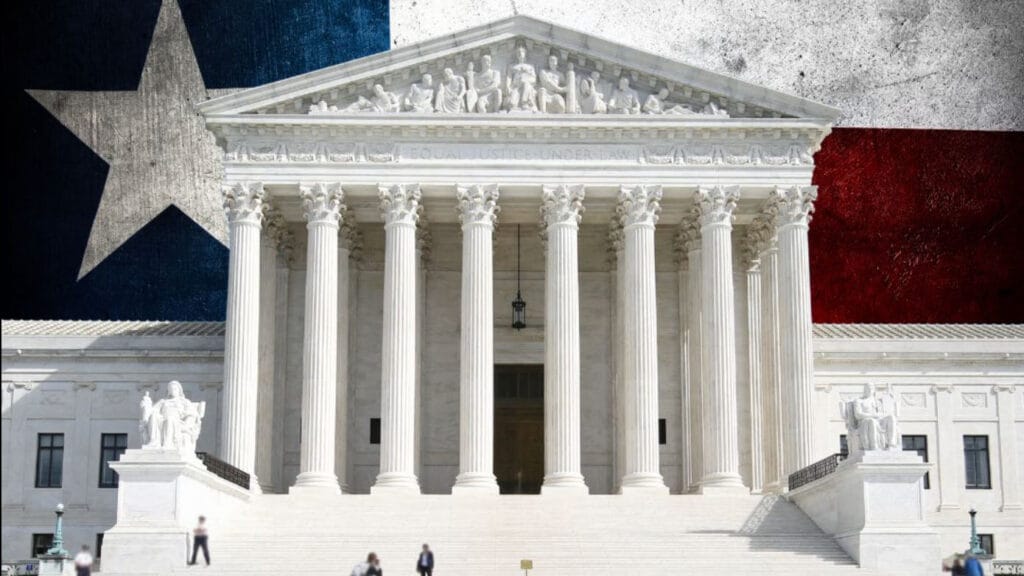
The Supreme Court has cleared the way for Texas to keep using a new congressional map in the 2026 elections, giving state officials a significant win in a closely watched redistricting fight. In a short, unsigned order, the Court put a lower court’s ruling on hold and signaled that Texas is “likely to succeed on the merits” of its appeal. The justices also faulted the lower court for stepping into the middle of an active election cycle, saying it disrupted the balance between state and federal authority in election administration.
The decision keeps in place a map that Republicans hope will strengthen their chances of expanding their advantage in Texas’ 38-member U.S. House delegation. Republicans currently hold 22 of those seats, and the party’s national majority remains narrow.
Justice Elena Kagan dissented, joined by Justices Sonia Sotomayor and Ketanji Brown Jackson. She wrote that the order allows Texas to run the next election with a map the district court found unconstitutional, saying it “disrespects the work of a District Cour that did everything one could ask to carry out its charge.”
The conflict began after the Justice Department warned Texas last summer that several congressional districts were unconstitutional “coalition districts,” arguing the state needed to address what DOJ called “racial gerrymandering.” Two days later, Gov. Greg Abbott instructed lawmakers to draw a new congressional map. The Legislature approved it in August, and Republicans projected the plan could allow them to win up to 30 seats.
Civil rights groups, led by the League of United Latin American Citizens, challenged the map almost immediately. They argued the state sorted voters by race in violation of federal law and asked a special three-judge court to prevent its use in 2026. Texas countered that the map was drawn for political reasons, pointing to President Donald Trump’s call for a plan that could help Republicans gain additional House seats.
On Nov. 18, two of the three district judges ordered the state to abandon the new map and revert to the plan passed in 2021. Judge Jeffrey Brown wrote that although politics played a part, the evidence showed “much more than just politics,” concluding that the Legislature engaged in racial gerrymandering. He also rejected DOJ’s earlier claim that “coalition” districts were unconstitutional, saying the department had pushed Texas to use race in a process the state said was race-neutral.
Brown added that changing maps now would not cause “significant disruption,” noting the primary was still months away. Judge Jerry Smith dissented sharply, criticizing how the majority handled the case and calling the ruling “the most blatant exercise of judicial activism that I have ever witnessed.”
Texas responded by asking the Supreme Court to intervene, stressing that shifting back to the old map so close to filing deadlines would be unworkable. The state also argued it was likely to prevail because the challengers had not offered an alternative map—something the Court has previously said could matter in cases where plaintiffs rely on circumstantial evidence. Texas maintained that counties, candidates, and voters had already been preparing under the new lines.
The Supreme Court’s order means the new map will remain in place while the case continues, shaping a key battleground state’s districts ahead of a closely contested 2026 midterm election.